

Family help with a down payment is one of the most common ways first time home buyers in Utah enter the market. A parent gift or loan from relatives can bridge the gap between what you have saved and what you need. But lenders and the IRS have specific rules about how gift money must be documented and sourced. Understanding these rules prevents delays, denials, or tax complications. This guide covers exactly what lenders require and how to use gift funds correctly.
What Is a Gift Fund?
A gift fund is money given to you with no expectation of repayment. It comes from an acceptable source, typically a parent or close family member. For FHA loans, acceptable sources include parents, grandparents, or other blood relatives. Employers can also provide gifts. For conventional loans, the rules vary by loan program.
The key distinction: a gift is not a loan. The giver cannot expect you to pay it back. If there is an expectation of repayment, lenders must count it as a debt you owe, which increases your debt to income ratio and may disqualify you.
This is why the paperwork matters. When you receive a gift, you need documentation that it is a gift, not a loan. Without that documentation, a lender might assume repayment is expected and deny your application or reduce the amount you can borrow.
Reference: HUD Handbook 4000.1 Section 5.3.1 (FHA Gift Fund Requirements) and Fannie Mae Selling Guide B3 3.1 (Conventional Gift Funds).
FHA Gift Fund Rules
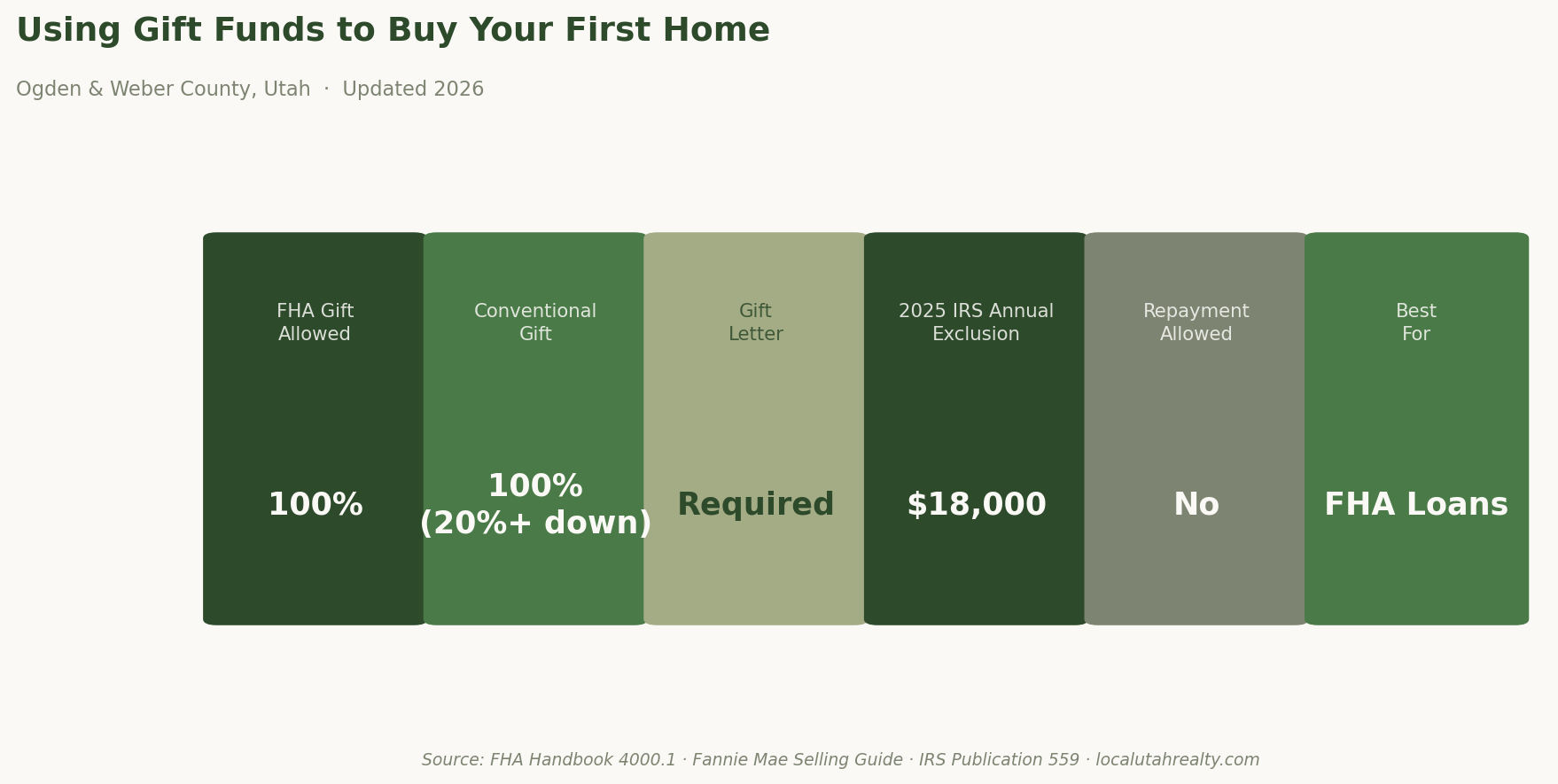
FHA loans are the most flexible with gift funds. The FHA allows 100 percent of your down payment to come from a gift. There is no minimum amount you must contribute from your own savings. If you put 3.5 percent down on a $350,000 home, all $12,250 can be a gift.
The gift must come from an acceptable source: blood relative, employer, or nonprofit organization. Friends are not acceptable sources for FHA loans. The giver must be able to gift the money without financial hardship, though the FHA does not formally verify this.
The gift must be just that: a gift with no repayment. The gift letter must explicitly state that no repayment is expected. If you later repay the donor, the FHA will not penalize you, but the initial arrangement must be a true gift on paper.
FHA requires a gift letter signed by the donor. The letter must include the donor's name and address, the amount of the gift, the property address, a statement that the funds are a gift with no repayment expected, and the donor's signature. Your lender will provide a template. You can also find standard gift letter language online.
Reference: HUD Mortgagee Letter 2021-05 and HUD Handbook 4000.1 Section 5.3.1.
Conventional Gift Fund Rules
Conventional loans have slightly different rules. For owner occupied primary residences with 20 percent or more down, 100 percent can be a gift. For loans with less than 20 percent down, rules vary by program. Fannie Mae HomeReady allows 100 percent of the down payment as a gift. Other conventional programs may require you to contribute some of your own funds.
Conventional loans also accept gifts from family members, employers, and nonprofits. The gift letter requirements are the same: written statement, no repayment expected, donor signature, and specific property information.
The difference with conventional loans is that they are more flexible about cash gift reserves. If you have substantial liquid reserves (savings) after closing, lenders view this favorably, even if the down payment itself came from a gift. This is called compensating factors and can help your application if other metrics are borderline.
Reference: Fannie Mae Selling Guide B3 3.1 (Gift Funds) and Freddie Mac Single Family Seller Servicer Guide Section 5119.
The Gift Letter: What It Must Include
The gift letter is the single most important document. Without it, your lender may treat the gift as a loan and count it against you. Here is exactly what must be in the letter:
- 1
Donor name and address. Full legal name and physical address of the person giving the gift.
- 2
Borrower name. Your full legal name as it appears on the loan application.
- 3
Relationship. State your relationship to the donor (parent, grandparent, aunt, employer, etc.).
- 4
Gift amount. Exact dollar amount being gifted. Be specific: $12,250, not approximately $12,000.
- 5
Property address. The complete address of the home being purchased.
- 6
No repayment statement. "This is a gift and no repayment is expected or required."
- 7
Donor signature and date. Signed and dated by the person giving the gift.
Here is sample language your donor can use: "I, [Donor Name], am giving [Your Name] a gift of [Amount] for use as down payment and closing costs on the purchase of [Property Address]. This gift is given voluntarily, with no expectation of repayment. [Date and Signature]"
Paper Trail Requirements and Documentation
Lenders do not just accept the gift letter. They want proof that the money actually changed hands. This is why paper trail documentation is critical.
The lender will ask for bank statements showing two things: (1) a withdrawal from the donor's account and (2) a deposit into your account. These statements must show the transfer of funds. For example, if your parent gives you $15,000, you need a statement from your parent's bank showing a withdrawal of $15,000, and a statement from your bank showing a deposit of $15,000 around the same date.
If the gift is transferred via wire, you need the wire transfer records. These typically show the sender, receiver, amount, and date. Wire transfers are actually easier to document because they create an automatic paper trail.
If the donor writes a check, you need the canceled check or online banking image showing it cleared. Your bank statement will reflect the deposit.
Large deposits need explanations. If your lender sees a sudden $20,000 deposit that was not discussed, they will ask where it came from. Be proactive and explain it with your gift letter and documentation. This prevents last minute application delays.
Reference: CFPB Mortgage Application Guide Section 3.2 (Verifying Assets and Source of Funds).
IRS Gift Tax Rules
Many people worry about IRS gift tax. The good news: for most people, giving a gift for a down payment has no tax consequences. However, understanding the rules is important.
In 2025, the annual gift tax exclusion is $18,000 per person. This means an individual can give up to $18,000 per year to another person with no tax filing required. A married couple can each give $18,000, totaling $36,000. If your parents give you a combined $36,000, no IRS Form 709 is required.
If the gift exceeds $18,000 per person in one year, the donor must file IRS Form 709 (Gift Tax Return). But filing Form 709 does not mean paying taxes. It applies against a lifetime lifetime exemption of $13.61 million per person. In 2025, unless someone has previously given away millions, filing Form 709 will result in zero tax owed.
The recipient (you) never owes gift tax. Gift tax is only paid by the giver, and only if they exceed their lifetime exemption. For a parent giving a child $50,000 for a down payment, they file Form 709 but pay no tax because they have not exceeded their lifetime exemption.
Most people worry about this unnecessarily. For practical purposes: gifts up to $18,000 per giver per year require no IRS filing. Larger gifts require filing but not payment. Consult a tax professional if your gift is unusually large.
Reference: IRS Publication 559 (Survivors, Executors, and Administrators) and IRS.gov Gift Tax page.
What Lenders Look For in Your Gift Documentation
Lenders are trying to answer three questions: (1) Is this truly a gift or a disguised loan? (2) Can the donor afford to give this amount? (3) Is there a clear paper trail?
To answer question one, they need your gift letter. The letter must explicitly state no repayment is expected. They also look at whether the gift covers exactly what you need or slightly more or less (exact matches can raise flags, suggesting fabrication).
To answer question two, lenders look at the donor's bank statements. They want to see that the withdrawal did not deplete their savings or leave them with inadequate funds. If your parent has $100,000 in savings and gifts you $15,000, no problem. If they have $16,000 and gift $15,000, a lender might question whether this is a true gift or a loan disguised as one.
To answer question three, they need the bank statements, wire records, or canceled checks showing the transfer. This is the most important part. Without documentation, the gift cannot be verified.
Seasoned versus unseasoned funds: Some lenders care about whether funds have been in your account for a set period (typically 60 days). These are called seasoned funds. If your parent gifts you money just days before you apply for the mortgage, a lender might ask for more documentation to confirm it is a gift and not a loan. If the funds have been in your account for 60 days, they are seasoned and less scrutiny is applied.
Steps to Use Gift Funds Correctly
- 1
Have the conversation early. Discuss with your intended lender before you receive the gift. Ask about their specific requirements. Some lenders have slightly different rules.
- 2
Prepare the gift letter. Use your lender's template or standard language. Have your donor sign it. Keep a copy for your records.
- 3
Transfer the funds. Have your donor wire the money to you or provide a check. Wire transfers are preferred because they create automatic documentation.
- 4
Keep your bank statements. Once the funds arrive in your account, save bank statements showing the deposit. If possible, wait 30 to 60 days before applying so funds become seasoned.
- 5
Provide all documents to your lender. When you apply for the mortgage, submit the gift letter, your bank statements showing the deposit, and your donor's bank statements showing the withdrawal (for wire transfers, keep the wire receipt).
- 6
Be honest if asked. If your lender asks additional questions about the gift, answer directly. If they ask whether you will repay it, say no and provide your gift letter as evidence.
Sources and References
- HUD Federal Housing Administration – Gift Fund Requirements and Handbook 4000.1
- Fannie Mae – Selling Guide B3.3.1 (Gift Funds)
- Freddie Mac – Single Family Seller Servicer Guide Section 5119
- Internal Revenue Service – Gift Tax Rules and Form 709
- Consumer Financial Protection Bureau (CFPB) – Mortgage Application Guide

 Wasatch Front Regional MLS - Salt Lake Board of REALTORS® All information deemed reliable but not guaranteed. All properties are subject to prior sale, change or withdrawal. Neither listing broker(s) or information provider(s) shall be responsible for any typographical errors, misinformation, misprints and shall be held totally harmless. Listing(s) information is provided for consumer's personal, non-commercial use and may not be used for any purpose other than to identify prospective properties
