

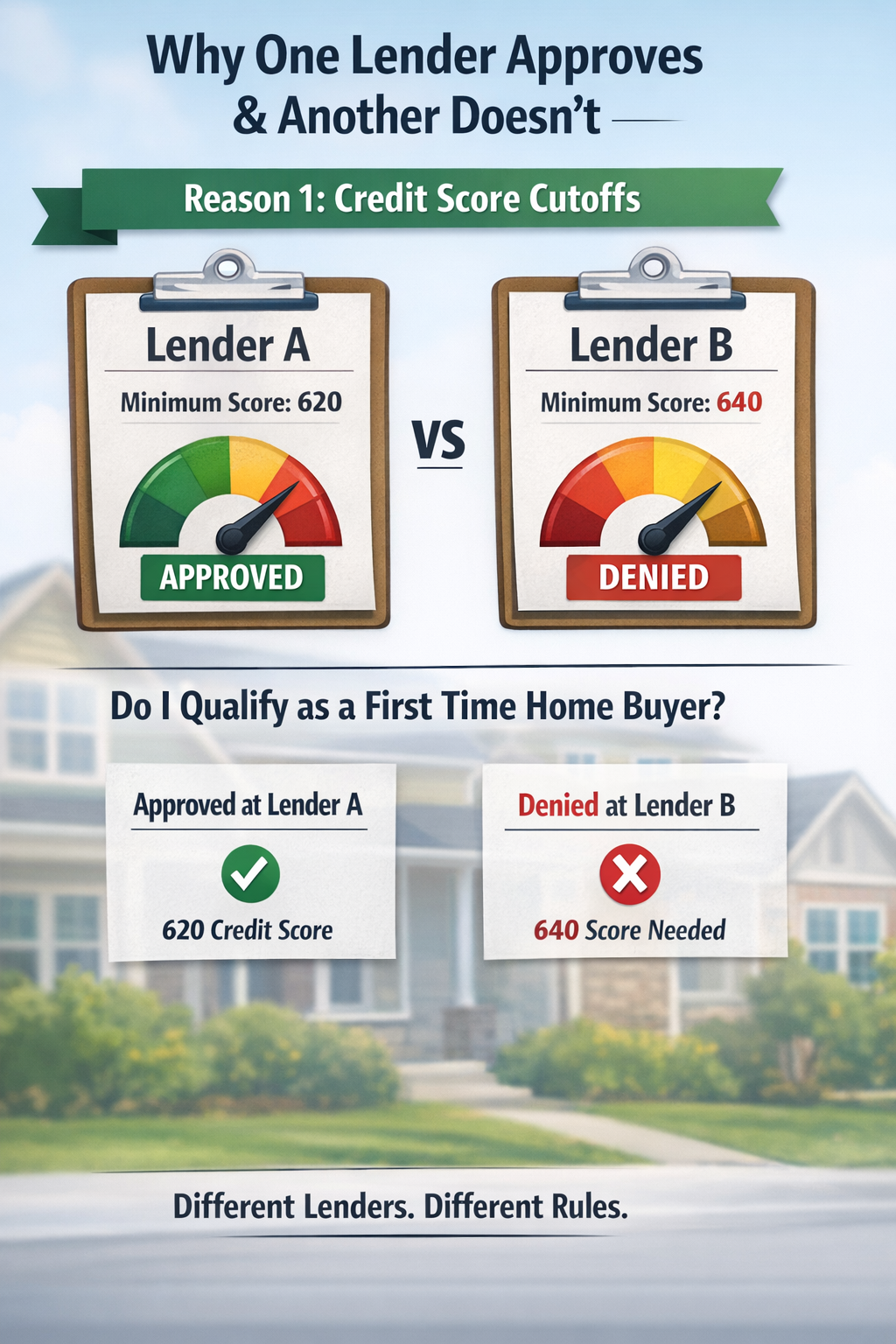
If you’ve ever been pre-approved by one lender and denied by another, you’re not alone — and you’re not doing anything wrong. This confusion often shows up when people are asking big questions like is now a good time to buy a house or do I qualify as a first time home buyer, and suddenly receive mixed signals from lenders. While mortgage lenders follow the same broad federal guidelines, they interpret and apply risk very differently.
This post breaks down three of the biggest (and least understood) reasons why approvals vary so much:
- Credit score cutoffs
- How income is calculated
- Each lender’s appetite for risk
Understanding these can save you time, frustration, and unnecessary stress — and help you avoid some of the most common mistakes first time home buyers make during the homebuying process.
1. Credit Score Cutoffs Aren’t Universal
Most buyers assume there’s a single credit score required to buy a home. In reality, credit requirements vary widely from lender to lender, even for the same loan type.
Why this happens
Loan programs like Conventional or FHA loans publish minimum credit guidelines — but lenders are allowed to set stricter standards. These extra requirements are often called lender overlays.
For example:
- One lender may approve a Conventional loan at 620
- Another may require 640 or 660 for the same product
Both are following the rules — just with different comfort levels.
What lenders look at beyond the number
Credit score is only part of the story. Lenders may weigh:
- Recent late payments more heavily
- Collections or charge-offs differently
- Credit history length
- Number of recent inquiries
That’s why two lenders can see the same credit report and reach different conclusions.
Key takeaway: A denial doesn’t mean your credit is “bad” — it often means that lender’s cutoff is higher than another’s. Many buyers wrongly assume this means they don’t qualify at all, which is one of the classic mistakes first time home buyers make.
2. Income Isn’t as Straightforward as Your Paycheck
Income seems simple: you earn X dollars per year, so that’s what counts — right? This is especially confusing for buyers wondering do I qualify as a first time home buyer when their income isn’t perfectly predictable.
Not exactly.
How income calculations vary
Lenders don’t just look at what you make now; they focus on stability and predictability. Different lenders interpret this differently, especially when income isn’t perfectly consistent.
Common areas where lenders diverge (especially relevant when buying a house with student loans or variable income):
- Overtime, bonuses, and commission — Some lenders count these only if consistent for 2 years. Others average more conservatively or exclude them altogether.
- Self-employed or 1099 income — One lender might average the last two years. Another may focus on declining trends or use net income after deductions, reducing your qualifying income significantly.
- Recent job changes — A job change within the same field may be fine for one lender, while another sees it as a risk.
💡 Your qualifying income directly affects your debt-to-income ratio (DTI). Even small differences in how income is calculated can push your DTI above or below a lender’s limit — especially for buyers carrying student loans.
Key takeaway: Two lenders can look at the same job and paycheck and calculate very different “usable” income.
Am I Ready to Buy a House in Utah?
Take this 5-question quiz to find out where you stand — and what your next step should be.
3. Every Lender Has a Different Risk Appetite
This is the least visible — but often most important — factor, particularly for buyers debating is now a good time to buy a house but feeling uncertain because of their financial profile.
What “risk appetite” means
Some lenders are built to be conservative. Others are designed to work with first-time buyers, variable income, or less-than-perfect credit profiles.
Factors that influence a lender’s risk tolerance include:
- How they sell or service their loans
- Their investor requirements
- Past loss experiences
- Their business model and target borrower
A conservative lender may:
- Require higher credit scores
- Cap DTIs lower
- Demand more cash reserves
A more flexible lender may:
- Allow higher DTIs with compensating factors
- Be more forgiving of past credit issues
- Specialize in non-traditional income scenarios
Key takeaway: Approval often depends less on you and more on whether your profile fits that lender’s risk model.
The Bottom Line: What This Means for First-Time Buyers
When one lender says no and another says yes, it usually comes down to:
- Different credit score thresholds
- Different income calculations
- Different tolerance for risk
It’s not a personal judgment — and it’s not a dead end.
The smartest move for buyers is to shop lenders, especially if your situation includes variable income, recent credit events, or non-traditional employment.
💡 The right lender isn’t just the one with the lowest rate — it’s the one whose guidelines actually fit you.
If you’re navigating conflicting lender decisions, working with someone who understands these differences can make all the difference. Give us a call!

 Wasatch Front Regional MLS - Salt Lake Board of REALTORS® All information deemed reliable but not guaranteed. All properties are subject to prior sale, change or withdrawal. Neither listing broker(s) or information provider(s) shall be responsible for any typographical errors, misinformation, misprints and shall be held totally harmless. Listing(s) information is provided for consumer's personal, non-commercial use and may not be used for any purpose other than to identify prospective properties
