

Most first time home buyers believe they need to save 20 percent down before they can buy. This myth costs thousands of buyers years of delayed homeownership and increases their total housing costs. The truth is far more encouraging. Today, qualified buyers in Ogden and Weber County can purchase a home with as little as 3.5 percent down. Some programs offer 0 percent down. Understanding your real options is the first step toward becoming a homeowner.
The 3.5 Percent Down Option with FHA Loans
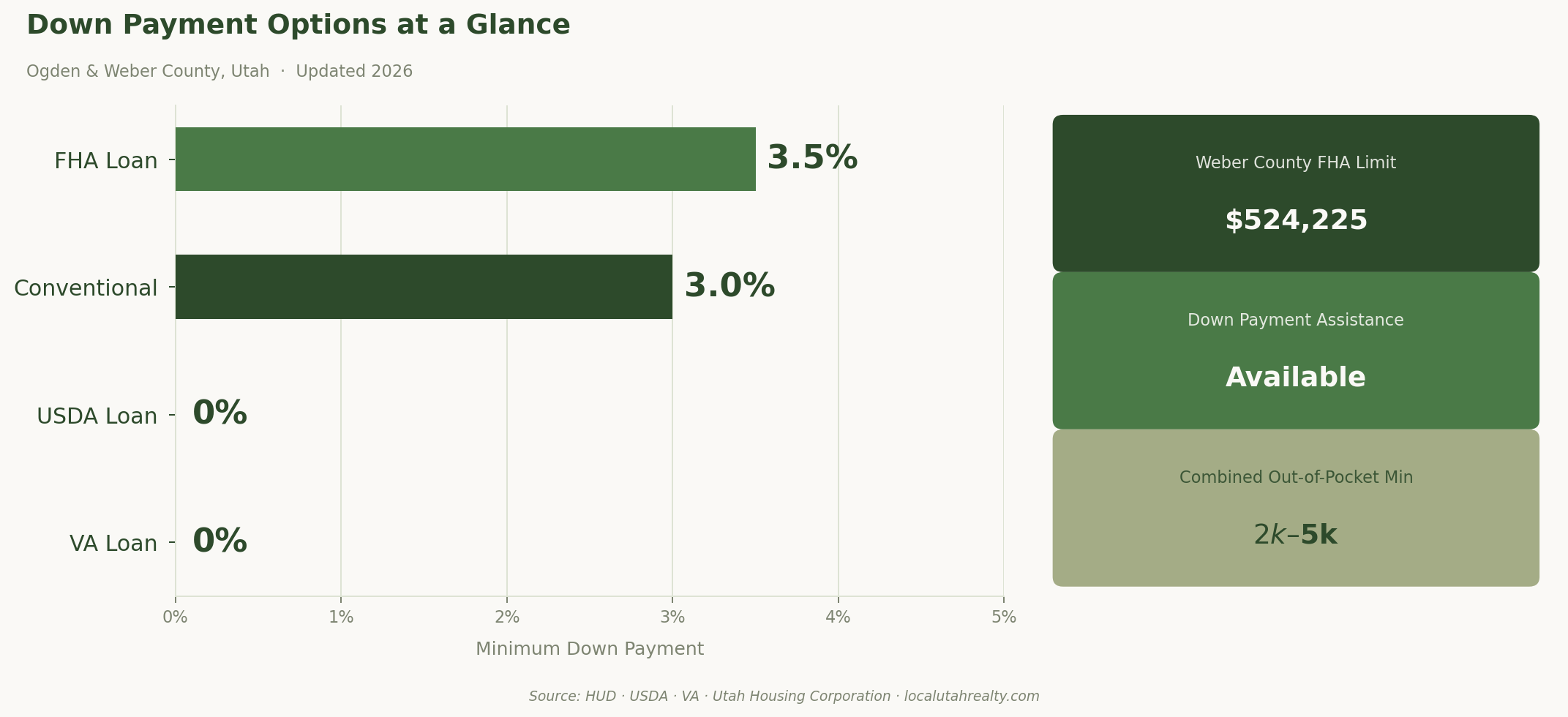
The Federal Housing Administration (FHA) loan program is the most accessible option for first time home buyers in Ogden. FHA loans require a minimum down payment of just 3.5 percent of the purchase price. For a $350,000 home, this means putting down only $12,250. That is more realistic for most working families than waiting years to accumulate $70,000 for 20 percent.
To qualify for an FHA loan in Weber County, you need a credit score of 580 or higher. There are no income restrictions for FHA loans, though your debt to income ratio cannot exceed 50 percent. The maximum loan amount in Weber County is $524,225, which covers most properties in Ogden and surrounding communities.
FHA loans do require mortgage insurance (called mortgage insurance premium or MIP). This protects the lender if you default. With a 3.5 percent down payment, you will pay 1.75 percent upfront and 0.55 percent annually. On a $350,000 loan, that is roughly $6,100 upfront added to your loan, plus about $160 per month in annual MIP. These costs are real but must be weighed against the benefit of homeownership three to five years earlier than waiting to save 20 percent. During that time, you build equity and benefit from appreciation.
Reference: HUD Mortgagee Letter 2025-03 and FHA Single Family Housing Policy Handbook 4000.1.
The 3 Percent Down Conventional Option
Conventional loans, which are not backed by a government agency, now require as little as 3 percent down through programs like Fannie Mae HomeReady and Freddie Mac Home Possible. These programs were created specifically to help first time home buyers access mortgages with lower down payments and more flexible qualifying criteria.
Conventional 3 percent down loans require a minimum credit score of 620. They also come with mortgage insurance (called private mortgage insurance or PMI), but PMI on conventional loans can often be removed once you reach 20 percent equity. You cannot remove FHA MIP regardless of how much equity you build.
Fannie Mae HomeReady and Freddie Mac Home Possible loans also allow non traditional credit (like rent and utility payments) to be counted in your qualifying profile. This is a major advantage if your credit history is limited. These programs are competitive alternatives to FHA, especially for borrowers with credit scores above 640.
Reference: Fannie Mae Selling Guide B3 3.1 and Freddie Mac Single Family Seller Servicer Guide.
Zero Percent Down with VA Loans
If you are a veteran, active duty service member, or surviving spouse, you may qualify for a VA loan. VA loans require zero percent down. You pay no down payment and no mortgage insurance. This is the most generous loan program available.
VA loans do require a Certificate of Eligibility from the Department of Veterans Affairs. The VA does not set a minimum credit score, but most lenders require 580 to 620. VA loans have no maximum loan amount in Utah, though lenders set their own limits based on your income and credit.
The VA guarantees a portion of the loan, which allows lenders to offer better terms. Your funding fee is the primary cost, typically 2.3 percent of the loan amount for first time VA borrowers. This can be rolled into the loan amount, so you do not pay it upfront.
Reference: U.S. Department of Veterans Affairs Home Loan Program, VA.gov/housing.
Zero Percent Down with USDA Loans
The U.S. Department of Agriculture offers loans for homebuyers in rural and suburban areas. Parts of Weber County and greater Ogden qualify. USDA loans require zero percent down and no mortgage insurance in the traditional sense. Instead, borrowers pay an upfront guarantee fee and an annual fee, similar to VA loans.
USDA loans have income limits. For a family of four in Weber County, the limit is typically around $100,000 to $110,000 in annual gross income. You must also own your property (this is for primary residences only), and the property must meet USDA size and condition standards.
USDA loans are often overlooked but provide a path to zero down homeownership for middle income families in eligible rural and suburban areas. The property location determines eligibility, so verify with your lender whether your target home qualifies.
Reference: USDA Rural Development Single Family Housing Guaranteed Loan Program, RD.USDA.gov.
Stacking Down Payment Assistance Programs
This is where Ogden and Weber County buyers get real advantage. The Utah Housing Corporation (UHC) offers second loans that cover down payments and closing costs. These programs stack on top of FHA or conventional loans.
Here is a realistic example: A first time buyer in Ogden wants to purchase a $350,000 home. With FHA, they need 3.5 percent down: $12,250. The buyer does not have $12,250 saved. Instead, they apply for an FHA loan plus a Utah Housing Corporation second mortgage. The UHC loan covers the $12,250 down payment and most closing costs. The buyer's total out of pocket: as little as $2,000 to $5,000.
This is not fantasy. Thousands of Utah buyers do this every year. You must use a UHC approved lender and meet income limits. Most buyers in Weber County qualify. The UHC second loan carries a fixed interest rate and is subordinate to your first mortgage, meaning the lender absorbs slightly more risk, but it works.
Reference: Utah Housing Corporation FirstHome Loan Program, utahhousingcorp.org.
The 20 Percent Down Myth
Why do so many people still believe they need 20 percent down? Because it is the number their parents heard decades ago. But the cost of waiting is extraordinary.
Imagine waiting five years to save $70,000 for 20 percent down on a $350,000 home. During those five years, that same home in Ogden likely appreciates to $400,000 or more (based on recent Weber County trends of 3 to 5 percent annual appreciation). Now you need $80,000 down. Meanwhile, you paid $1,500 per month in rent: $90,000 total gone, building no equity.
If you bought today with 3.5 percent down, you would own the home, build equity, and benefit from appreciation. The mortgage insurance you pay is real but temporary. It costs far less than the opportunity cost of waiting.
This does not mean 20 percent down is always wrong. If you have the funds available and rates are high, it can make sense. But for most first time buyers in Weber County, the real calculation is: buy now with 3 to 3.5 percent down, or stay renting while waiting to save more.
Quick Comparison of All Down Payment Options
| Loan Type | Min. Down Payment | Min. Credit Score | Mortgage Insurance | Max Loan (Weber) |
|---|---|---|---|---|
| FHA | 3.5% | 580 | Yes (MIP) | $524,225 |
| Conventional (3%) | 3% | 620 | Yes (PMI) | Unlimited |
| VA | 0% | 580 (lender) | No (funding fee) | Unlimited |
| USDA | 0% | 640 | No (guarantee fee) | Unlimited |
| FHA + UHC 2nd | 0% out of pocket | 580 | Yes (MIP) | $524,225 |
How to Get Started Today
- 1
Check your credit score. Visit AnnualCreditReport.com for your free annual credit report. You do not need a perfect score to buy. Even 580 opens doors with FHA. Scores above 640 unlock more options.
- 2
Calculate your debt to income ratio. Add up all monthly debt payments (car, student loans, credit cards, other mortgages). Divide by your gross monthly income. Most loan programs allow up to 43 to 50 percent DTI. If you are over, pay down credit cards or consider increasing income.
- 3
Get pre approved. Meet with a mortgage lender in Utah. Ask them specifically about FHA, conventional 3 percent, and Utah Housing Corporation programs. Get a written pre approval letter showing what you qualify for.
- 4
Explore down payment assistance. If using FHA, ask your lender about stacking a Utah Housing Corporation second mortgage. This can reduce your out of pocket cash to almost nothing.
- 5
Get a real estate agent. Partner with an agent who understands first time buyer programs. They will help you navigate offers, inspections, and appraisals with confidence.
Sources and References
- HUD Federal Housing Administration – Mortgagee Letter and policy guidance
- Fannie Mae – HomeReady program and selling guide
- Freddie Mac – Home Possible program and guidelines
- U.S. Department of Veterans Affairs – VA home loan program
- USDA Rural Development – Single family housing programs
- Utah Housing Corporation – FirstHome and assistance programs
- AnnualCreditReport.com – Free credit reports
- Consumer Financial Protection Bureau (CFPB) – Mortgage guidance

 Wasatch Front Regional MLS - Salt Lake Board of REALTORS® All information deemed reliable but not guaranteed. All properties are subject to prior sale, change or withdrawal. Neither listing broker(s) or information provider(s) shall be responsible for any typographical errors, misinformation, misprints and shall be held totally harmless. Listing(s) information is provided for consumer's personal, non-commercial use and may not be used for any purpose other than to identify prospective properties
